“Utility lost their 345 north of here,” Miguel said. “Trying to reroute through the eastern corridor. They’re maxed out on reactive compensation. Told us to expect more swings until they get another thermal unit ramped.”
“Any major trips?” I asked, fingers already tapping commands.
“We lost one of the smaller furnaces for a minute,” Tiffany said. “Operator saved the heat. Casting had some issues—mold level control freaked when voltage dipped, but they managed.”
I nodded. “Okay. We’re going to isolate some of the noise. Tom, switch out capacitor bank three. It’s fighting us more than helping at this point. Miguel, keep an eye on the harmonic filters. If they start saturating, yell.”
“What about the arc furnaces?” Tiffany asked. “They’re riding the ragged edge.”
“We’re going to talk them through it,” I said. “One at a time. We can’t shut everything down, but we can stagger and smooth. Get me melt shop on one.”
She patched them in. The operator’s voice came through, tight but controlled. These guys stand next to the lightning every day. You don’t survive long in that room if you panic easily.
“This is Janet,” I said. “We’re going to ride this out. I need you to trust me and do exactly what I say, when I say it, even if it feels weird.”
“You’re the boss,” he said. I heard relief in his tone he probably didn’t realize was there.
Eric arrived at 9:58, like he’d been waiting outside the door for the exact right moment to enter. He’d lost the suit jacket somewhere. His tie was loosened. His hair looked less perfect than usual, as if the humidity had finally gotten to it.
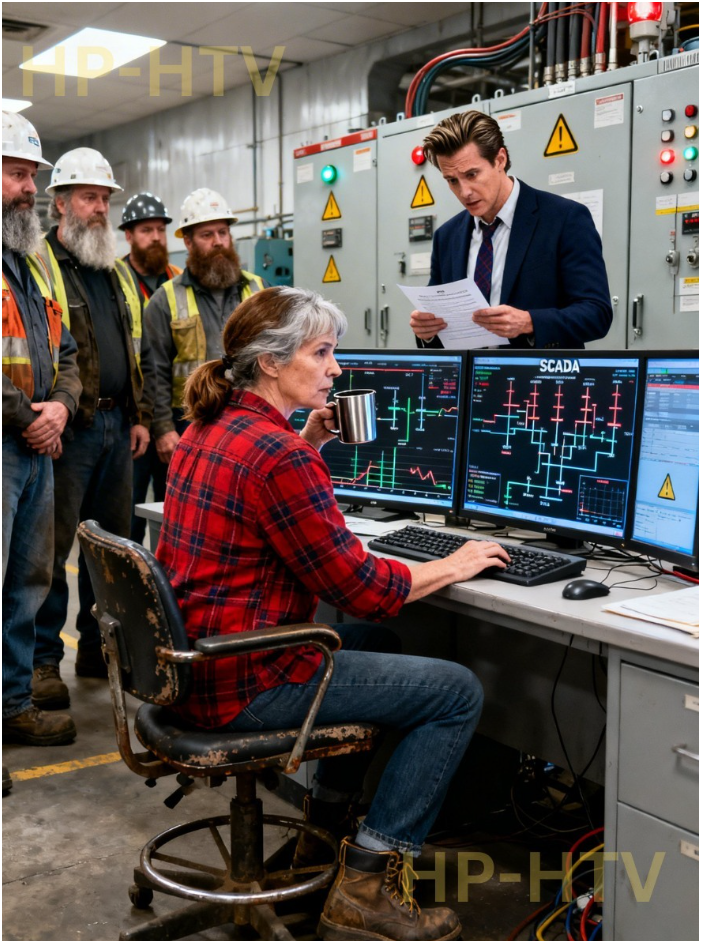
He stepped into the control room. The temperature drop hit him; goosebumps rose on his bare forearms. He glanced at my team clustered around the consoles, at the graphs on the screens, at the voltage numbers bouncing like heartbeats.
“Janet,” he said.
“Not now,” I said, eyes on the screen. “Sit down. Don’t touch anything.”
To his credit, he did exactly that. He found an empty stool along the wall and perched on it like a kid in detention.
For the next two hours, the plant and I danced.
Voltage dropped; I switched in a capacitor here, switched one out there. Frequency drifted; I modulated load where I could, asking one furnace to delay a tap, another to extend a hold. The SCADA system screamed alarms at me like a toddler having a tantrum. I silenced the ones I knew were noise, listened for the one that indicated something truly off.
There’s an art to it that’s hard to explain to someone who thinks automation is binary—on or off, working or failed. When you know a system as intimately as I know this one, you can feel it through the screen. You know when a voltage swing is just the grid yawning, and when it’s the first twitch of a seizure.
The consultants’ fancy new suite would have looked at those same graphs and decided to trip some things, shut some things off, preserve others. It would have followed its logic tree and ended up with a neat report about why everything went dark and how to prevent it next time.
I had no interest in “next time.” I had interest in now.
At 10:37, one of the main feeder breakers chattered in a way that made the hair on the back of my neck stand up.
“Feeder two,” Miguel said, pointing. The ammeter was oscillating. Current wasn’t steady.
“Ground fault?” Tom asked, hand hovering over the trip control.
“Not yet,” I said. “Hold.” I watched the waveform on another screen, compared it to the last hour, to last week, to a hundred other times I’d seen weirdness from that part of the plant.
“Switchgear B,” I muttered. Of course it was B.
Switchgear B, the ancient, temperamental piece of equipment I’d been begging to replace for five years, humming away in a remote corner of the plant, fed half the mill and all of the admin building. Its breaker handles had personalities. Its insulation crept toward the edge of acceptable, then backed off when I threatened it aloud.
“Get maintenance down to B,” I said. “Have them check for visible issues. Hot spots. Smell.”
“Smell?” Eric echoed quietly from his stool.
“Yes, smell,” I said. “You ever smelled a cable about to let go? It’s distinctive. You never forget it.”
He didn’t press.
Maintenance reported back five minutes later. “We’ve got a hot spot on one of the bus connections,” the electrician said over the radio. “IR gun says it’s flirting with ninety degrees.”
“Flirting with ninety is fine,” I said. “Dating ninety-five is not. We can’t shut it down right now without creating a bigger mess.” I thought for a second. “Grab a box fan, point it at it, and promise it we’ll replace it in the morning if it behaves.”
The electrician laughed despite himself. “Copy that. Romantic bus promises, here we come.”
The utility called twice during the night. Once to apologize for the fluctuations. Once to tell us they’d finally stabilized the northern line.
Around 2:14 a.m., the voltage graphs settled. The frequency line flattened. The alarms calmed down.
The beast exhaled.
My shoulders did too.
I leaned back in my chair, rolling my neck until it cracked. My coffee had long since gone cold. I drank it anyway.
Eric stood up from his stool. He looked… different. A little smaller. A little less glossy. His shirt was wrinkled. His eyes had shadows under them that hadn’t been there that morning.
“I knew it was complicated,” he said quietly. “I didn’t know it was… that.”
“That,” I said, “was a mild night.”
He let that sink in.
Tom clapped me on the shoulder as he passed by. “Nice catch, as always,” he said, then headed out to check on his crew and plan the replacements I’d just promised on the radio.
Miguel and Tiffany started logging the night’s events, capturing timestamps, waveforms, notes. In six months, when everyone else had forgotten how close we’d come to a very bad day, those logs would be my receipts.
Eric stayed where he was.
“I owe you an apology,” he said.
“You owe a lot of people an apology,” I said. “Start with them.” I nodded toward the door, where you could see operators through the glass, wiping sweat from their faces under fluorescent lights.
He swallowed. “I will.”
“And the other thing?” I asked, holding out my hand.
He passed me a stack of papers. The new agreement. My name. His. The board’s. The clauses exactly as I’d dictated. Direct reporting line. Budget autonomy. Consultant access by my approval only.
I flipped through it, scanning for any weasel words. Lawyers love weasel words. So do executives.
It was cleaner than I expected. Maybe Linda had insisted on that. Maybe Eric had, for once, realized that bargaining with the person who just kept his plant from bricking itself was not the time for cleverness.
I signed it. He signed it. We shook hands.
His hand was softer than mine. I didn’t hold it against him.
“Why do you stay?” he asked suddenly. It wasn’t the question I expected.
“What?” I said.
“Here,” he said. “You could go anywhere. Utilities. Tech companies. Countries that aren’t held together by duct tape and stubbornness. Why stay here?”
I looked around the control room. At the screens. At the worn-out chair. At the whiteboard with a dozen half-erased notes about next week’s planned outage. At the coffee ring on the desk that matched the bottom of my oldest mug.
“Habit,” I said. “Responsibility. Masochism. Take your pick.”
He laughed weakly.
“Also,” I added, “because somebody has to teach the beast new tricks before the old tricks stop working entirely. And I’d rather that somebody not be a cloud service that doesn’t understand what ten tons of steel looks like when it’s about to harden in the wrong place.”
He nodded slowly. “Teach me,” he said.
I raised an eyebrow. “You want to learn to run SCADA?”
“I want to learn enough,” he said, “to not call things heavy when they’re holding the whole place up. I can’t be you. But I can be less of an idiot.”
It was the most self-aware thing I’d ever heard him say.
“We’ll see,” I said. “First lesson is humility. You already got a crash course. Second lesson is listening. You’re doing that now. Keep it up.”
I stood up and stretched. My back popped. I’m not getting any younger. My hands still remember how to do everything, but my knees complain louder than they used to when I climb the yard ladders.
“I’m going home,” I said. “I’ll be back on Monday. Between now and then, don’t let anyone sell you software that promises to replace common sense. It never ends well.”
He smiled, tired and genuine. “Yes, Janet.”
As I walked out, past the hum and the flicker and the smell of hot metal, I felt something I hadn’t in a while.
Not anger. Not resentment. Not the bitter satisfaction of being right.
Relief.
Relief that the beast had been fed and soothed for another night. Relief that the people inside it were safe. Relief that, for now, I still had a place at the console.
Later, when the adrenaline drained and the fatigue set in, I sat at my kitchen table again with the severance folder, now obsolete, beside my thermos.
I didn’t shred it. Not yet. I just put it back in the drawer.
Nothing is permanent. Not jobs. Not plants. Not beasts.
Someday, I’ll hang up my hard hat for good. My knees will insist. My hearing will be too far gone from years of hum. Time will do what time does.
Before that happens, though, I’m going to make sure that the knowledge in my fingertips doesn’t vanish when I do.
I’ve already started.
Tiffany has been shadowing me more. I’ve been patient when she asks questions that feel obvious to me but aren’t to her. I’ve made her put her hands on breakers, on transformer skins, on that one relay panel that lies. “Feel it,” I tell her. “Smell it. Listen.”
We’ve been writing things down. Not in cryptic text files only I understand, but in proper documentation. Annotated schematics. Playbooks for events like last night. Lists of “if this, then that” that aren’t just logic, but judgment.
I’ve been telling more stories in the break room. Not war stories to show how tough I am, but cautionary tales to show why this stuff matters.
Because the truth is, plants like this don’t survive on steel and software.
Ze overleven van mensen die geven om mensen. Mensen wier hart een beetje sneller klopt als het gezoem van toon verandert. Mensen die het gewicht van verantwoordelijkheid niet als een last, maar als een voorrecht voelen.
Mensen die hun afdeling niet als zwaar zien.
Ze zien het als de ruggengraat.
Ik heb dit beest twintig jaar in leven gehouden.
Nu is het tijd om ervoor te zorgen dat het zonder mij kan leven.
Maar niet zonder mensen zoals ik.
Niet zonder iemand die begrijpt dat een systeem zichzelf nooit draait. Het loopt omdat iemand, ergens, luistert.
Als je wilt doorgaan, klik dan op de knop “Volgende” hieronder 
Advertentie