Toen noemde Eric mijn kennis « zwaar. »
Dus heb ik ze wel opgeruimd.
Een voor een opende ik elk bestand, scande het en vroeg mezelf: « Staat dit ergens anders opgeschreven? Weet iemand anders dit? Heeft iemand de moeite genomen om erom te vragen? »
Als het antwoord ja was, liet ik het staan.
Als het antwoord nee was, drukte ik op verwijderen.
Ik heb ze niet naar een usb-stick gekopieerd. Ik heb ze niet naar mezelf gemaild. Ik heb ze niet uitgeprint en onder mijn matras verstopt. Ik liet ze gewoon verdwijnen. Twintig jaar aan vingertopherinneringen, verdwenen in kleine wolkjes elektronen.
Het voelde als een gecontroleerde brand.
Ik saboteerde de plant niet. De kerndocumentatie was er nog steeds. De eenregelige diagrammen, de apparatuurgegevens, de instellingen van het beschermingsrelais. Dat alles leefde in gedeelde drives en gedrukte ordners. Niemand kon mij ervan beschuldigen iets te hebben gedaan dat de veiligheid of betrouwbaarheid schaadde.
Het enige wat ik deed was het kussen verwijderen. De extra kennislaag die alles soepeler, sneller en minder snel misliep als het grid op dinsdagavond hikte.
Als ze geloofden dat het systeem zichzelf draaide, zou ik ze laten ervaren wat dat echt betekende.
De uitnodiging voor de vergadering arriveerde op een woensdag.
« Herstructureringsbespreking, » stond er op de onderwerpregel. Geen agenda. Geen context. Slechts drie namen: die van mij, die van Eric en Linda van HR.
Ik staarde er een minuut naar. Toen klikte ik op « Accepteren. »
Donderdag om negen uur, vergaderruimte drie.
Ik kleedde me die ochtend zorgvuldiger aan dan normaal. Schone spijkerbroek. Schoon flanellen overhemd. Ik haalde zelfs mijn oudste paar werkschoenen tevoorschijn—de schoenen die twee keer opnieuw waren gesoled en er nog steeds nieuwer uitzagen dan ik me voelde.
Op de terugweg stopte ik bij de controlekamer en controleerde de logboeken van de nacht. De spanning was stabiel geweest. Geen alarmen waar je je zorgen over maakt. Het beest sliep diep als het wist dat iemand luisterde.
Ik maakte een verse kop koffie voor mezelf, nam een slok en zette die toen op mijn bureau. Het voelde symbolisch.
Vergaderruimte drie rook naar printertoner en zenuwen. Er hangt een bepaalde geur in HR-vergaderingen waarvan je weet dat het niet over een promotie gaat.
Eric zat aan het hoofd van de tafel in een marineblauw pak zo scherp dat het kaas kon snijden. Linda zat rechts van hem, een manillamap voor zich, pen op de rand van de tafel uitgelijnd alsof ze iets in de kamer wilde controleren, al was het maar briefpapier.
« Janet, bedankt dat je gekomen bent, » zei Eric, alsof ik een keuze had.
Ik nam plaats op de stoel tegenover hen. Het been was wiebelig. Natuurlijk was dat zo. Niemand doet ooit moeite om de wiebelige stoelen in vergaderruimtes te repareren.
Eric begon met de toespraak. Je kon zien dat hij het had geoefend.
« We hebben besloten om verder te gaan met een slankere organisatiestructuur, » zei hij. « Jouw rol overlapt sterk met de geautomatiseerde monitoringsuite die we volgend kwartaal uitrullen. De consultants hebben de cijfers doorgerekend, en eerlijk gezegd is het rendement op het nieuwe systeem overtuigend. »
Linda schoof de map naar me toe. Ontslagovereenkomst. Dat kon ik aan de dikte zien. Zestien weken loon, waarschijnlijk. Sommige voordelen blijven bestaan. Niet-openbaarmaking, niet-denigratie. Hier tekenen, haal je box.
“We’re not blind to your contributions,” Eric added, trying for sincere. “Twenty years is impressive. But the future is data-driven. Real-time analytics. Predictive maintenance. We just can’t justify the overhead of… manual tribal knowledge.”
There it was again. Tribal.
I let the silence stretch. People underestimate silence. They rush to fill it with more words, more justification. I sat there and listened to the faint vibration from the HVAC fan, the tick of the clock on the wall, the distant rattle of a forklift in the hallway.
Finally, I asked, “When’s the next grid event forecast?”
Eric blinked. “Excuse me?”
“The utility,” I said. “They send us bulletins when they expect trouble. Peak loads, storms, outages. When’s the next voltage excursion predicted?”
He glanced at Linda, who glanced back, unhelpful. “I’m sure the system—”
“Yesterday,” I said. “Three seventeen p.m. Cold front dropping down from Canada tonight. Wind farms tripping offline in Iowa. Coal plants near max. Tight margin on the regional grid. They expect flickers. Brownouts. Maybe worse.”
I watched him calculate the odds that I was bluffing.
“We have protections in place,” he said. “Automatic transfer. UPS systems. The new suite will handle it.”
“The new suite isn’t installed yet,” I said. “The old systems are already running at the edge of what they can do without someone who knows where the bodies are buried propping them up.”
I tapped the folder with one finger. “Cut me loose now, and tomorrow night, when the voltage dips and spikes like a heart on a monitor, you’re going to be relying on logic controllers held together with chewing gum and my old code.”
Eric’s jaw tightened. “Are you… threatening us?”
“It’s not a threat,” I said. “It’s a forecast. Just like the utility’s. You asked why you need me. I’m telling you. What you do with that information is your business.”
I stood up slowly. The chair wobbled, caught, settled.
“Oh, one more thing,” I said, hand on the back of the chair. “Those personal notes I keep? The ones everyone calls tribal knowledge?”
Eric’s eyes flickered. “Yes?”
“They’re gone,” I said. “Deleted. Not uploaded. Not printed. Not backed up. Just gone.”
Linda sucked in a breath. Eric’s face went very still.
“You can’t—” he started.
“Sure I can,” I said. “They were mine. My fingers. My brain. You decided my brain was a line item you could delete. I adjusted accordingly.”
“That information belongs to the company,” Linda said, finding her voice. “You developed it in the course of your employment.”
“That information lived in me long before you put it in a spreadsheet,” I said. “You wanted systems that run themselves. Now you have them. Congratulations.”
I picked up the folder. Tucked it under my arm without opening it.
“Enjoy your lean operations,” I said. “If you change your mind before the lights go out, you know where to find me.”
Then I walked out.
I didn’t slam the door. I didn’t throw the folder away dramatically. I just let the fluorescent-lit, carpeted world of conference rooms and HR fade behind me as I walked back toward the hum.
The control room felt colder than usual when I stepped inside. I sat in my chair, the good one, the one with my groove worn into it. I stared at the screens.
On one of them, a little window showed the utility’s bulletin, timestamped yesterday.
POTENTIAL VOLTAGE EXCURSIONS 19:00–01:00 DUE TO SYSTEM CONSTRAINTS. EXPECTED MAGNITUDE ±10%. CUSTOMERS ADVISED TO REVIEW SENSITIVE LOAD PROTECTIONS.
We have a lot of sensitive loads.
I poured myself a fresh cup of coffee and watched the clock tick toward evening.
They didn’t call that afternoon. They didn’t call at four or five. At six, I went home. Fed the cat—a stray that adopted me and ignored me in equal measure. Took a shower hot enough to pink my shoulders. Sat at my kitchen table with the severance folder in front of me and a pen next to it.
Sixteen weeks. COBRA. Nondisclosure. Non-disparagement. Handcuffs dressed up as a gift basket.
I could sign it. I could start applying for jobs at utilities, other plants, engineering firms. People need power engineers. Twenty years of experience is no small thing. I’d land somewhere.
But the thought of this plant, this beast I’d lived with for two decades, sitting there with only wires and code between it and chaos? It made my chest feel tight.
At eight forty-seven, my phone rang.
Not my cell—my old landline, the one only a handful of people have the number to. The caller ID showed the plant’s main line.
I let it ring twice before picking up.
“Janet,” Linda’s voice came through, thin and high. “We’d like you to come in. Tonight. Please.”
The background noise told me everything. It was louder than usual. Beeps. Voices. Someone swearing off-mic.
“What changed?” I asked.
She hesitated. “The utility just called. There was an unplanned outage on one of the 345 kV lines. Voltage is already… unstable. We’ve had three nuisance trips in the last half hour. The arc furnace almost dropped on its last heat.”
“Almost?” I said. “Or did and nobody wants to say it out loud?”
She exhaled. “It dropped. We caught it before the bath froze, but the operators had to scramble. They’re… asking for you.”
They. Not Eric. The operators. The guys who actually have to stand near ten tons of liquid steel when the lights flicker.
“I’ll come in,” I said. “On one condition.”
“Name it,” she said without missing a beat. It’s funny how fast HR can negotiate when their own jobs are on the line.
“Eric signs a new employment agreement,” I said. “My department reports directly to the board again, like it did under his father. No cuts to my headcount without my sign-off. No consultants touch my systems without my written approval. My budget is restored. And he apologizes, in front of the shift crew, for calling my department heavy.”
She was quiet for a long time. I heard paper rustling, the murmur of another voice—Eric, I guessed—somewhere near the phone.
“That’s… a lot,” she said finally.
“So is jackhammering a frozen ladle,” I said. “I know which one I’d prefer.”
She didn’t argue. “He’ll do it,” she said. “We’ll have the paperwork ready.”
“Good,” I said. “I’ll see you in twenty minutes.”
I hung up, grabbed my thermos, my hard hat, my badge. The cat watched me from the arm of the couch, tail flicking, unimpressed.
The drive to the plant is fifteen minutes on a good day. That night, it felt longer. The sky to the north flickered, not with lightning, but with the strange, transient glow of a disturbed grid. Streetlights dimmed and brightened in waves. Traffic signals blinked on battery power at a major intersection.
By the time I pulled into the employee lot, the beast was already restless. You could hear it in the way the hum warbled. You could see it in the way lights flickered in ripples across the main building.
The security guard at the gatehouse waved me through before I even held up my badge. “They’re looking for you,” he called, as I drove by.
I parked in my usual spot, third row, near the light pole with the chipped paint. The air smelled of wet asphalt and hot steel.
Inside, the corridors were more crowded than usual for that hour. Shift supervisors, maintenance, production foremen, all moving with the same tight, purposeful urgency. Nobody was running, but nobody was strolling either.
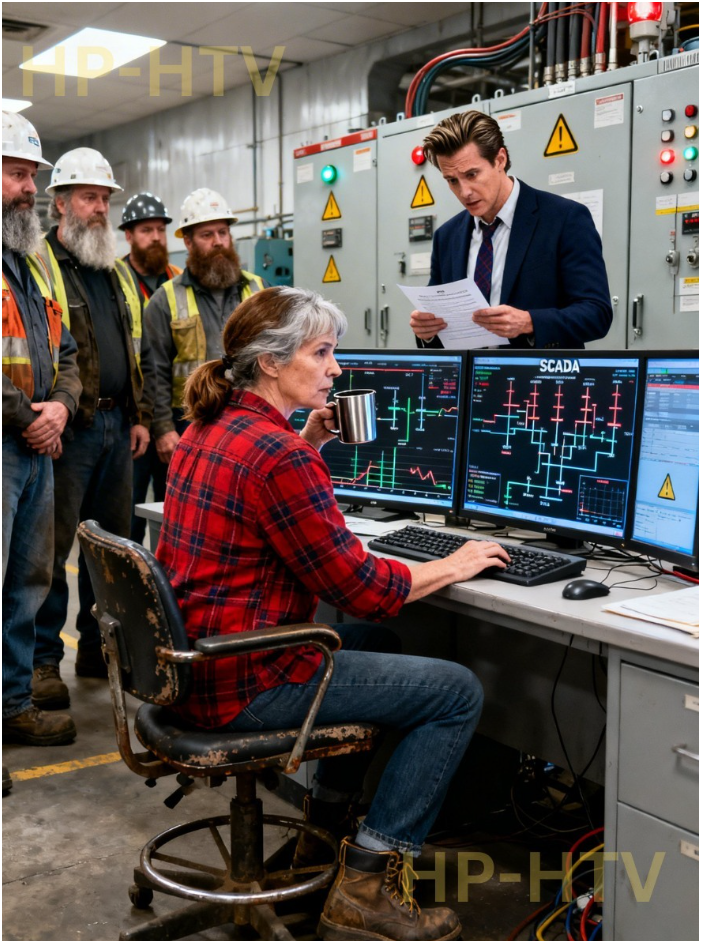
I stepped into the control room at 9:22. Every seat was filled except mine. Three of my guys were there—Tom, with his gray beard and NASCAR hat; Miguel, who could rebuild a motor starter blindfolded; and Tiffany, the first woman I’d hired into my team ten years after I started.
They looked up when I walked in. No cheering, no clapping—this isn’t a movie. Just three nods, accompanied by three tiny exhales.
“About time,” Tom muttered, half-grin on his face. “We were about to start pulling levers at random.”
“You do that and I quit again,” I said, dropping my thermos on the desk and sliding into my chair.
The screens told their own story. Voltage at the main transformer fluctuating ten percent either way from nominal, frequency riding low, reactive power dancing like a drunk. The utility’s tie line status showed yellow flags all over.
“How bad?” I asked…
Als je wilt doorgaan, klik dan op de knop “Volgende” hieronder 
Advertentie
Lees verder door hieronder op de knop (VOLGENDE 》) te klikken !