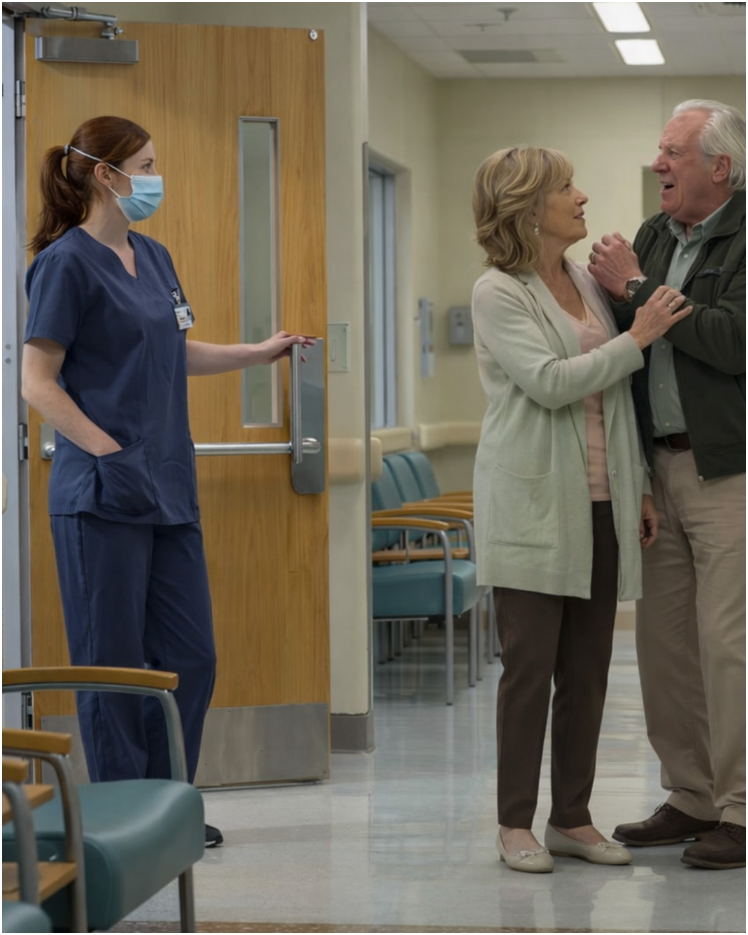
“Dit is niet het moment of de plaats hiervoor, Helena. Je zus ligt op de intensive care.”
‘Ik weet het,’ antwoordde ik kalm. ‘Ik heb net drie uur en veertig minuten besteed om ervoor te zorgen dat ze het overleeft. Dus ja, pap, ik ben me ervan bewust.’
Hij had niets te zeggen.
Voor het eerst in mijn leven stond mijn vader – die altijd een beslissing, een bevel of een oordeel paraat had – volkomen sprakeloos.
De stilte deed wat ik nooit had gekund.
Vijf jaar lang onbeantwoorde telefoontjes, teruggestuurde brieven en genegeerde e-mails hadden niets veranderd. Maar hier staan, levend en wel, met het bewijs op mijn borst – dat sprak boekdelen, meer dan welke uitleg ik ook had gegeven.
Mijn moeder greep naar de rugleuning van een stoel om zich vast te houden.
‘De brieven,’ fluisterde ze. ‘Je zei dat je brieven had gestuurd.’
“Two emails, with my leave-of-absence paperwork attached. One handwritten letter mailed priority. You returned it unopened. I recognized your handwriting.”
She pressed a trembling fist against her mouth.
My father stared down at the floor.
“I called fourteen times in five days,” I continued quietly. “I asked Evelyn Parker to talk to you. You told her to stay out of it.”
I wasn’t accusing them. I was simply stating facts.
Facts don’t need volume.
At that moment, Angela stepped into the doorway. She didn’t know the entire story yet. She only had hospital business.
“Dr. Reed, I’m sorry to interrupt,” she said. “The board chair reviewed the overnight trauma report. He asked me to pass along that the physician excellence award committee sends their congratulations for tonight’s surgical outcome.”
She said it casually, the way you’d mention any routine message. She had no idea she had just dropped a second bomb.
My mother stared at me through swollen eyes.
“Physician of the year?”
“It’s just an internal recognition,” I said. “Nothing important.”
I turned to Angela. “Thank you. I need to check post-operative vitals.”
Then I walked toward the ICU corridor, steps measured, back straight.
I didn’t look back, but behind me I heard my mother’s voice, small and broken.
“Andrew… what have we done?”
And I heard something I had never heard from my father before.
Nothing.
For the first time in his life, silence was the only honest thing he had left.
Four hours later, I entered ICU room six.
The monitor beeped steadily while pale morning light filtered through the blinds. I began the standard post-operative check—vital signs, drainage output, wound inspection, routine work.
Except nothing about this situation was routine.
Vanessa’s eyes were open. They were glassy from anesthesia, unfocused at first. She blinked slowly at the ceiling, then at the IV stand. Eventually, her gaze drifted toward me.
She squinted. Her eyes moved to my badge, then back to my face, then to the badge again.
The color drained from her face the same way I’ve seen it drain from patients who have just received terrible news.
“Helena?”
“Good morning, Vanessa,” I said evenly. “I’m your attending surgeon. You suffered a ruptured spleen and a grade three liver laceration in the accident. Surgery was successful. You’re expected to make a full recovery.”
“You’re a doctor.”
“I’m the chief of this department. I have been for two years.”
I watched the realization unfold slowly across her face. The same emotional progression my father had gone through, but slower, dulled by morphine—confusion, disbelief, fear, and finally something I recognized immediately.
That familiar flicker in her eyes.
Calculation.
Even now, lying in a hospital bed with the stitches I placed holding her liver together, Vanessa was already trying to figure out how to twist the story.
“Helena, listen,” she said weakly. “I can explain.”
“You don’t need to explain anything to me,” I replied calmly.
I nodded toward the glass door, where two figures stood in the hallway, their faces pale and eyes red from lack of sleep.
“You need to explain it to them.”
I finished updating her chart, checked the drainage line, and left the room without another word.
I didn’t stay to hear what happened next.
But the entire ICU floor did.
Her room wasn’t soundproof, and neither was the truth.
All right, let me pause for a moment. What do you think Vanessa told my parents when they walked into that ICU room? Option A, she finally told the truth. Option B, she doubled down on the lie. Option C, she played the victim again. Drop your answer in the comments.
And if you haven’t subscribed yet, this is the moment, because what happened next is where everything started collapsing.
Later, I learned the details from Angela Ramirez, who heard it from the ICU nurse who heard everything through the glass.
If you chose option C, congratulations.
You know my sister well.
The moment my parents entered the room, Vanessa burst into tears—loud, shaking sobs that pulled painfully at her surgical stitches and sent the heart monitor climbing.
“Mom, Dad, you have to believe me,” she cried. “I never wanted it to go this far. I was just worried about her.”
My father stood stiffly at the end of the bed. His voice was tight with restraint.
“Vanessa, Helena is a surgeon. She’s the chief of trauma surgery at this hospital.”
“I didn’t know that,” she said quickly.”
“She told us she sent letters, emails. She called fourteen times. She asked Evelyn to talk to us.”
My mother’s voice sounded hollow.
“Is that true?”
Vanessa shook her head weakly. “She’s exaggerating. You know how she—”
“Evelyn tried to tell us,” my father interrupted, and this time his voice cracked—not with sadness, but with the collapse of something he had believed for five years. “Two years ago, she told us Helena was in residency, that she was a surgeon. You said Evelyn was lying. You said she was trying to stir up trouble.”
“Evelyn doesn’t know the whole story.”
“What is the whole story, Vanessa?”
My mother was shouting now in the middle of an ICU. The nurse at the station outside flinched down the hallway. Someone visiting another patient looked up from their phone.
And Vanessa, cornered in a hospital bed with IV lines in both arms and my sutures across her abdomen, did what she always did.
She shifted from defense to attack.
“Fine,” she snapped. “She’s a doctor. Good for her. But she abandoned this family.”
“She never called because we blocked her number, Vanessa,” my father said, gripping the bed rail so tightly his knuckles turned white. “Because you told us to.”
The heart monitor kept beeping. The IV pump clicked quietly.
And for perhaps the first time in her adult life, Vanessa Reed had no script left.
Evelyn Parker walked into the ICU at 9:45 that morning. I had called her after the surgery—not as a weapon, but because Vanessa was her niece too, and she deserved to know.
But Evelyn arrived prepared.
Five years of silence will do that to a person with a strong memory and a well-organized filing system.
She didn’t sit. She didn’t hug anyone. She stood in the middle of the room and said, “I’ve waited five years to have this conversation. I’m not waiting one more minute.”
She pulled out her phone and opened a folder she had labeled, I would later learn, Helena evidence.
Inside were screenshots of every email I had sent my parents during those desperate first days. The official PDF approving my leave of absence from UCSF School of Medicine, signed by the dean and stamped by the registrar. My reenrollment confirmation. A photo from my residency graduation—me in a cap and gown holding my diploma.
Evelyn stood next to me in that photo, the only family member there.
She handed the phone to my mother.
“And here,” Evelyn said, scrolling to another message thread, “this is a text Vanessa sent me four years ago.”
She read it out loud.
Don’t tell Mom and Dad about Helena’s residency. It will only confuse them. They’re finally at peace.
The room went completely silent.
Vanessa stared up at the ceiling.
The calculating expression I had known my entire life was gone. In its place was something new.
The look of someone who had finally run out of places to hide.
“You told me to stay quiet for the sake of the family,” Evelyn said, looking straight at her. “But this family hasn’t had peace. It’s had a five-year blackout.”
Then she turned toward my parents.
“And the two of you allowed this to happen, not because you didn’t love Helena, but because believing Vanessa was easier.”
No one argued.
There was nothing left to argue.
My mother slowly sank into the chair beside Vanessa’s bed, but she wasn’t looking at Vanessa anymore. She was scrolling through Evelyn’s phone, reading every email I had sent. Her lips moved silently as she read.
She stopped at the last one, the email I had written the night before my residency graduation.
I know exactly what it says. I’ve reread it countless times in my Sent folder.
Mom, I don’t know if you’ll ever read this. I graduated from residency today. I wish you were here. I’m still your daughter. I never stopped being your daughter.
My mother doubled forward in the chair, not crying. It was something deeper than that. It was the sound of someone finally feeling the full weight of a mistake that can never truly be undone.
My father stood by the window with his back to the room. His shoulders were shaking.
Als je wilt doorgaan, klik dan op de knop “Volgende” hieronder 
Advertentie