‘Beloof het me,’ zei ze.
And because of everything she had given me, because of everything she was asking without saying, I promised.
I didn’t ask what was inside.
I didn’t ask why.
I tucked it into my bag that night and carried it through the final days—through the hours when her breathing slowed and the room filled with the quiet presence of hospice nurses who spoke in whispers and moved like shadows.
I carried it to the funeral without thinking, feeling its weight every time I shifted in my seat.
I carried it home, walked past Ryan and Lisa with it resting against my side, walked out the door with it still sealed—still untouched.
Keeping that promise had felt like the last thing I could do for her, the last way I could prove I was listening.
Now, sitting on the edge of a motel bed that creaked under my weight, I finally understood.
The envelope hadn’t been meant for comfort.
It had been meant for timing.
She had known I would be surrounded by noise—voices speaking over mine—people trying to define my worth for me.
She had waited until she was certain I would be alone enough to hear the truth.
Inside the envelope was not money.
Not a letter filled with apologies or explanations.
There was a small metal key taped carefully to a folded piece of paper.
The key was cold against my skin when I lifted it out—heavier than it looked, the kind used for old-fashioned lockboxes.
A white tag was attached with neat handwriting.
First National Bank—safe deposit box.
I unfolded the paper slowly, recognizing Margaret’s writing immediately. The careful, deliberate strokes that had grown shakier over the years but never lost their precision.
Elena, it began—my name centered at the top of the page.
If you’re reading this, then I’m gone, and I need you to listen to me now the way you always have.
My throat tightened.
I had to stop, pressing the paper flat against my knee.
I know my children, she wrote. I have made excuses for them for too long—the same way you have. But I see clearly now.
My hands trembled as I kept reading.
I know what they will try to do.
The will they show you is not the real one.
The real will is in the box.
There is also a video.
I did this to protect you.
It’s already set in motion.
A chill ran through me.
Not fear—recognition.
She hadn’t been guessing.
She had been preparing.
Call Mr. Harris.
The note continued, followed by a phone number written carefully in the margin.
He helped me with everything.
He knows.
He has been waiting for you.
I’m sorry I couldn’t make this easier.
You deserve better than what comes next.
At the bottom, in smaller letters, she had added:
Please forgive me for not being braver sooner.
I love you.
I sat there for a long time, the paper resting in my hands, the key glinting dully under the motel’s weak light.
There was no rush of triumph.
No sudden relief.
What I felt instead was a deep, quiet sadness mixed with something else I hadn’t expected.
Recognition.
Margaret had seen me—not just as the daughter-in-law who stayed, not just as the caregiver who made her life possible, but as a person who needed protecting.
She had known I would not fight loudly.
That I would not demand what I was owed.
So she had done it for me, the only way she knew how.
I thought back to all the nights she’d apologized for needing help.
All the times she’d thanked me for things that should never have required gratitude.
I had told her she didn’t owe me anything.
Sitting there now, I realized how wrong I had been.
She hadn’t owed me money or a house.
But she had owed me the truth.
And she had given it to me—sealed inside an envelope—waiting for the moment I would finally be ready to open it.
The motel room felt different then, less oppressive, as if the walls had eased back just a little.
I folded the note carefully and placed it back inside the envelope, wrapping the key in the paper the way she had intended.
I wasn’t ready to act yet.
I didn’t know what the next step would look like.
But for the first time since I had walked out of my house, I felt something solid beneath my feet.
Not hope exactly.
Something steadier.
The knowledge that Margaret had anticipated this moment.
That she had trusted me to find my way to the truth when everything else had been taken from me.
I slipped the envelope back into my bag and zipped it closed.
I lay back on the bed, staring at the ceiling, listening to the heater’s uneven rattle.
Tomorrow, I would call the number she had written down.
Tomorrow, I would step into whatever she had prepared for me.
But tonight, I allowed myself one quiet thought—one that settled gently into place.
She hadn’t left me empty-handed.
She had left me a way forward.
I slept a few hours that night—the kind of sleep that comes from exhaustion rather than peace.
When I woke, the motel room was filled with pale morning light, the heater silent for once, as if it too had given up.
For a moment, I didn’t remember where I was.
Then I saw my bag on the chair.
I felt the weight of the envelope inside it.
And everything settled back into place.
I washed my face in the tiny bathroom, stared at my reflection, and barely recognized the woman looking back at me.
She looked older than she had a week ago—sharper around the eyes, quieter somehow.
I took the envelope out, checked the number Margaret had written, and sat on the edge of the bed with my phone in my hand for a long time before I dialed.
The line rang twice.
A calm voice answered—measured and steady, the kind that doesn’t rush.
I said my name.
There was a pause on the other end, just long enough to feel deliberate.
“Yes,” the man said. “I was wondering when you’d call.”
He gave me an address downtown, in an older part of the city I hadn’t been to in years, and told me to come by that afternoon.
No questions.
No surprise.
Just certainty.
I hung up and felt something shift inside me—subtle but undeniable.
For the first time since the funeral, I wasn’t reacting.
I was moving forward.
Het advocatenkantoor bevond zich boven een bakkerij in een rustige straat.
Ik rook de geur van versgebakken brood door het trappenhuis terwijl ik naar boven liep.
Het gebouw was opgetrokken uit oude bakstenen, die door decennia van weer en wind gladgesleten waren; het soort plek dat er al stond lang voordat trends bestonden en er nog lang daarna zou staan.
Het kantoor was vanbinnen eenvoudig, bijna bescheiden.
Houten meubels.
Ingelijste certificaten, aan de randen vergeeld.
Geen glazen wanden.
Geen scherpe lijnen.
Een receptioniste knikte naar me en gebaarde naar een open deur.
Ik stapte naar binnen en klemde mijn tas stevig vast alsof het mijn redding was.
De man achter de balie stond op toen hij me zag.
Hij was ouder dan ik had verwacht – wit haar, rustige maar precieze bewegingen.
Zijn ogen straalden een vriendelijke blik uit die oprecht aanvoelde, niet geoefend.
Hij stak zijn hand uit.
Toen ik het pakte, was zijn greep stevig – hij gaf me houvast.
‘Elena,’ zei hij. ‘Ik ben blij dat je gekomen bent.’
Hij vroeg niet hoe het met me ging.
Hij betuigde geen medeleven.
Hij gebaarde naar een stoel en wachtte tot ik ging zitten voordat hij zelf tegenover me plaatsnam.
Even was het stil.
Hij bekeek me aandachtig, alsof hij me de ruimte gaf om te beslissen waar ik moest beginnen.
Ik greep in mijn tas en legde de envelop op zijn bureau, waarna ik hem naar hem toe schoof zonder hem opnieuw te openen.
Hij knikte alsof hij niets anders had verwacht.
‘Je schoonmoeder is acht maanden geleden bij me op bezoek geweest,’ zei hij uiteindelijk. ‘Ze was heel duidelijk. Heel vastberaden.’
Hij klonk niet verrast.
Hij klonk respectvol.
‘Ze vroeg me geduld te hebben,’ vervolgde hij. ‘Ze zei dat als je ooit zou komen, het zou betekenen dat de dingen precies zo waren gelopen als ze had gevreesd.’
Ik vertelde hem wat er gebeurd was.
Niet in detail.
Alleen de feiten.
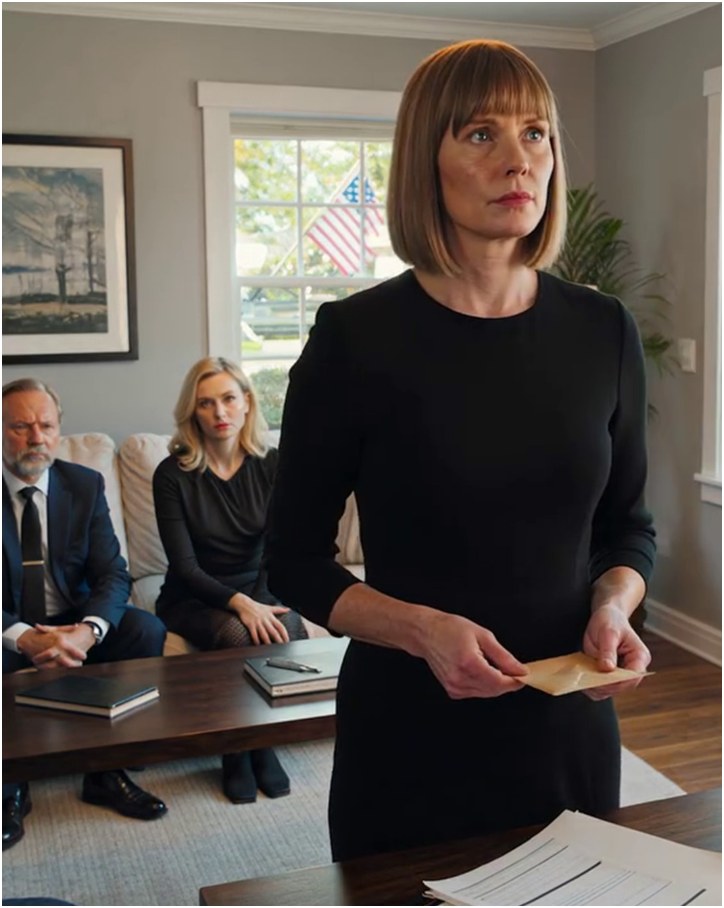
De woonkamer.
Ryan.
Lisa.
Als je wilt doorgaan, klik dan op de knop “Volgende” hieronder 
Lees verder door hieronder op de knop (VOLGENDE 》) te klikken !